Categories
Blog posts in English

Can Psychiatric Care be Improved by IT?

Picture this: You are diagnosed with a heart problem and hospitalized to have it treated. You meet the doctor, who will be responsible for your treatment and you ask him what is going to happen to you.
He is clearly only remotely interested in you, but directly addressed, he mentions that you will be operated. Otherwise he only mumbles about the fact that you’re very ill, and that you will probably never recover completely. You will get an injection and if you don’t corporate, they might consider using force to ensure that you do. Don’t worry too much, though, he says, and leaves you, clearly signalling that he’s too busy to talk to you, and that after all, you’re just the patient.
Such treatment of patients would be scandalous in somatic care, but in psychiatric care all over the world, it happens routinely.
Fortunately, things are changing. Former Danish prime minister Poul Nyrup Rasmussen hosts a yearly ”Pscychatric Summit Meeting”, where users of psyhicatry and their peers get together to discuss problems, actions and trends. There are top politicians attending the meeting, but the ”stars” are the users – or patients as we often call them.
His summit meetings have already helped improving things a lot, pushing psychiatry to depart from the old paradigms of force and medicine based treatments, moving towards a user centered approach. We’re not there yet: Recently a case of systematic, life dangering, overmedication of patients in Copenhagen was revealed. But the situation is clearly improving.
There’s no doubt that if we are to change psychiatric care, we need to focus on values, but we will also need new ways of treating patients, and one of the more promising trends is to employ information technology in psychiatric care.
We’re not talking brain scanners or electromagnetic brain therapy machines, though. We’re not even talking neurofeedback therapy. No, what we’re talking about is communication technology. Thats why we call it tele-psychiatry, implying the increased use of tele-communications.
During the Psychiatry Summit Meeting last Saturday October 6th, I participated in a workshop organised by the danish ADHD Foreningen on tele-psychiatry.
Our hyphothesis is that tele-psychiatry could possibly improve treatments by:

  • Eliminating barriers – it’s easier to get in touch with your doctor.
  • Empowering the patient – psychiatrists should get off that soap box, stop talking down to the patient, and face him or her as a peer.
  • Improved coordination of treatments between different sectors, hospitals etc.
  • Less transport time wasted by patients.
  • Reducing anxiety and fear for some patients by allowing them to stay in touch with their caretakers without leaving home.

On the other hand, we worry that tele-psychiatry could also make things worse by:

  • Patients becoming more lonely
  • Tele-psychiatry is just a way for politicians to save money
  • Some users will feel alienated
  • It will be forced on users, further reducing their feeling of control over their own lives.

Text on the t-shirt reads: Mental illness does not make people dangerous

The workshop was only about 1 ½ hour, but the conclusions were never the less very, very interesting:

  • Voluntarity is important: The user should always decides for herself or himself whether information technology is something he or she would want to use in hers or his communication with caretakers. This applies both to apps or programs used by the user to record his or hers emotions, sleep or other aspects of mental health, as well as to tele conferencing tools (e.g. Skype).
  • Tele-psychiatry should not replace any existing parts of treatment programmes: It should supplement treatment programmes.
  • What about information safety? If you’re meeting face to face with a doctor, you can be pretty certain noone is listening, but when you are meeting your doctor over the Internet, you don’t know who might be listening in on you. The possibility of information leaks should be taken seriously.
  • Ethics: If you’re a psychiatrist communicating with a patient over Skype, you might gain insight in things going on in the patients home. How do you deal with that?
  • How will the virtual communication space affect what is being communicated? We need to know this to make sure treatment plans still apply (e.g. systematic interviews conducted by psychiatrists could be affected by this).
  • It will be easier to capture daily problems: Many users in psychiatry find it difficult to remember or to convey their experiences to the doctor during the regular meetings. With communication more easily accessible, this could improve and the doctor would be better able to make the right descisions about treatments.
  • Social networks should be included, not excluded from the technology. Peers are often the best ”doctors”.
  • Politicians should not treat tele-psyhicatry as the new magic technology which will allow them to save money and improve care at the same time.

Even though I’ve been working with information technology for almost 20 years now, I was initially very sceptical about tele-psychiatry, thinking that we need to be careful not to waste what we have. The workshop made me realise that tele-psychiatry can improve psychiatric care. I intend to follow the technology developments closely, primarily from the user side, but – if opportunities turn up – possibly also professionally.

Categories
Blog posts in English

I'm Puzzled and Bugged: An odd mouse click problem on Win7

Updated 12th October: Problem has vanished! Read below.
I’ve come across a very annoying and strange defect on my Windows 7 laptop. It really bugs me!
Here are the patterns I’m seeing:

  • Sometimes, the minimize/restore/close buttons don’t light up when I hover the mouse above them. Clicking them has no effect. Whenever this happens, Alt-Tab’ing to another window and than Alt-Tab’ing back again restores them and they work again.
  • In Firefox, this happens as soon as I have clicked once somewhere inside the window.
  • The same applies to Thunderbird, my e-mail application.
  • Mouse clicks in popup windows sometimes end up in the window below the pop up window. E.g. clicking the close button on a popup window does not close the window, but does something in the window below it.
  • Other applications don’t seem to suffer from the problem, but has other types of odd mouse behaviour.
  • In Libre Office, I can’t click-and-drag to select text any more. Text selection is only possible by keyboard.
  • The scroll wheel doesn’t work in Internet Explorer
  • Capture One Pro 6 (a photo editing application), dragging sliders (to control photo appearance) no longer works.

I’m puzzled and bugged. But I’ll find out what’s wrong.
Oh and, by the way: I have tried restarting. It doesn’t help.
— Update 23rd September:
As per Michael Boltons suggestion, I connected a new mouse: A Wacom tablet. It didn’t change anything.
I ran Windows update and Sony’s own update tool to update various drivers. It also didn’t change anything.
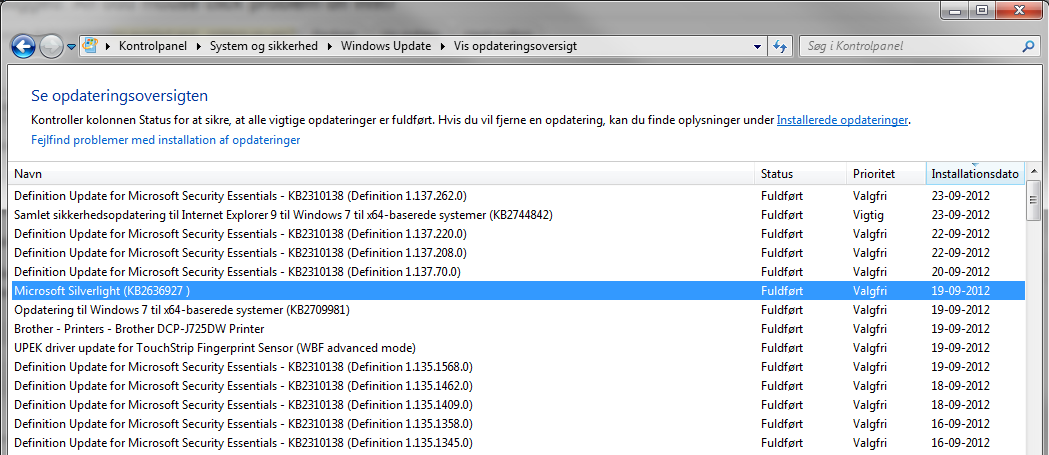
I’m pretty sure the problem started in the middle of the week. At first, I just thought it needed a restart and I was too lazy to do so, so it might have been there for a few days before I reacted. I haven’t installed any software, but I have run Windows update. The update log shows this:

I’ll try to uninstall the Silverlight update, as I’m suspecting it as ‘new and fancy technology’ might put in hooks in odd places in Windows.
— Update 12th October
I have a confession: The problem went and came back a few times, and now it’s gone completely. I feel like a lousy tester since I haven’t been able to dig out what caused it. Uninstalling software didn’t help, updating drivers didn’t help either, and even updating various software from Firefox, Thunderbird and Capture One Pro did not change mouse behaviour. I’m let with a well working laptop (that’s good!), the memory of a very annoying problem, and some lousy theories about what caused the problem.
Is this a case of a system error, which cannot be understood in the sense that there was a single cause, but has to be analyzed using a system perspective: A system of thousands of components interacting in complex ways? Like I suggest we analyse Black Swans in IT systems?
In that case, did something turn up the heat? I was a bit stressed myself at the time, but no – I don’t think my mental state affected this. And I can’t think of something.
My best guess is that a Firefox plugin for html debugging in combination with a specific version of the application and possibly some driver issues somehow ‘turned up the heat’ causing the problem to materialize. But it’s only a guess.
(By the way: I could have done like most would probably do: Reinstalled the pc or bought a new one. But just a few weeks before I did actually reinstall it completely with a new SSD and more RAM.)

Categories
Blog posts in English

A buggy business model

Dropbox is sending users e-mails like the one below. But there’s a problem: My dropbox is not nearly full. It seems Dropbox is including files in other peoples folders which have been shared read/write with me in the calculation of how much space my files are taking up. This is obviously a bug.
Or is it? Dropbox is marketing their service as a file sharing service, and they’re encouraging users to use it to share photos and other stuff with friends and relatives. This marketing is paying off: Users are signing up like never before (I know that because I see more friends signing up). As new Dropbox users start sharing files with me, the amount of space remaining on my Dropbox account is reduced. Essentially they’re asking me to pay for other users’ files.
There’s an alternative, though: I can earn space by asking others to sign up, thereby accelerating the problem.
I’m sure this is going to earn Dropbox a lot of revenues, so it should probably be counted as a feature. I’d call it a buggy one, since users will notice, and I’m sure this will kick back on Dropbox.
I don’t remember who said it, but it’s still true: If you’re offered something for free on the internet, then that something is not the product. Then you are the product.
Billede

Categories
Blog posts in English

Communicating models: A psychological perspective

Simon Morley posted a very interesting post about Challenges with communicating models about two weeks ago. Mental models are what we unconscously use to understand a situation, and communicating models to others is an interesting challenge: “[…] models do not transmit themselves – they are not necessarily understood on their own – they need the necessary “synch’ing” to align both parties to achieve comprehension, communication and dialogue”, as Simon summed it up in a comment on the blog post.
Simons post and the very good discussion he and I had about it started me thinking on the psychological perspective and how important empathy is: The “synch’ing” relies on empathy.
I really liked Simons blog post because above all it highlights the subjectivity of mental models. Models are not something you can implement in an organisaton just by e.g. e-mailing them to all employees. If you want someone to ‘get’ your model, you need to actively communicate it. Which is not possible without empathy.
Empathy is something that we associate with friendship and love, but it plays part in all communication processes between human beings, including those we as testers engage with at work.
From time to time we come across people who seems to have a total lack of understanding of what we’re doing: Colleagues, managers, customers. Most of the time, people who don’t understand need only a good explanation of the situation and our point of view. But sometimes, an explanation isn’t enough: Some people just don’t seem to want to understand.
People under pressure or in stress can be like that, and we often associate this with aggressive behaviour, rudeness. Or maybe we just see the rudeness, and only later realise that maybe there was a problem with understanding.
Empathy seems to exclude this behaviour. Empathy relies on a cognitive ‘feature’ of our brain which attempts to copy thoughts and feelings of other people: It tries to decode what those who you interact with are thinking based on verbal as well as unconscious ques, e.g. body language. It’s quite obvious that having ‘a notion’ of what someone else thinks and feels can make communication much more successful – if you feel sympathy for the other persons feelings and thoughts.
This can work both ways: Loss of empathy in a situation can mean that you think everybody else thinks and feels the same as you, and it can cause quite a lot of confusion and frustration when you realise that other’s are’nt thinking the same as you.
It can happens to all of us: The brain is not a perfect and consistently operating machine, but rather a very adaptable and flexible organ. For example in situations of crisis, empathy is one of the first things to go. A person in a crisis shift from being a social creature to goal oriented and focused, typically on survival – at any cost.
There are people who don’t want to understand, e.g. due to politics. But there are some people who involuntarily just aren’t able to get to ”the other side” of the argument, for example because they’re having ”a bad day”.
(Some people with autism and ADHD can be characterised by having problems with empathy. This is a quite severe handicap for them, since not only do they have problems decoding what other people think og feel, they can also have problems seperating their own thoughts and feelings from what other people are thinking and feeling. The sad situation for empathy impaired people is that they often don’t have a choice: Even when everything is good is it extremely difficult for them to decode other peoples thoughts, feelings and intentions – and therefore extremely difficult for them to communicate and interact successfully. Noticing how successfully others interact often just makes them feel plain stupid. This can lead to severe depression.)

Categories
Blog posts in English

Turning up the Heat

– What are you doing?
– I’m turning up the heat. To see if anything catches fire. It’s an old CID trick.

Detective Chief Inspector Jack Frost in the TV series “A Touch of Frost”

In the follow up post after my presentation at Let’s Test, I concluded that the next step in my work on black swan testing should be on operationalisation. This post introduces a a testing heuristic which I’ve successfully used myself. I call it “Turning up the Heat”
The basic idea is that odd things happen when a system is put under pressure, and that we can learn stuff about the system by doing so.
There are basically three ways to do it:

  • Load testing, i.e. putting the system under exceptionally heavy load for a period
  • Soak testing, i.e. loading the system lightly for a long time
  • Destructive testing, e.g. crippling subsystems by disabling or forcing malfunctioning

They can of course be combined.
In the quote above, heat is a metaphor for the psychological pressure Jack Frost is subjecting suspected murderers to, and here ‘load’ is also a metaphor for any environment changes that can have an impact on the way the system works. It could be a high data load, e.g. 10 or 100 times the normal rate of requests to a service, but it could also be something quite different, e.g. a 10 degrees higher than normal temperature in the server room. The black swan domain is the systems domain, so any component in the complete system is a valid target for putting load on.
Likewise, ‘crippling’ is a metaphor here for doing something to a subsystem that will cause the subsystem to work differently from normal: It could be as simple as just removing a component, or bugs could be deliberately introduced. In fact the target doesn’t have to be one single subsystem: Changing the same thing in several subsystems, e.g. compile all software modules with a buggy version of some widely used library, can be a simple and efficient apporach.
As testers, we often don’t have direct access to the tools needed to load and cripple subsystems and complete systems. I find that in order to practically “turn up the heat”, I often have to rely on the help of others, e.g. developers and system administrators. This leaves me with a communication and cooperation challenge which should not be taken lightly.
There are no right or wrong approaces in testing, but there’s a risk of wasting time: I.e. spending time on preparations and never getting down to the actual testing – thereby not learning. That’s one of the reasons I usually prefer simple techniques rather than planned approaches.
In one project I’ve worked on, the testing tool we used had a simple load testing function. I managed to crash the test environment completely by just running the tool off my own pc, and this eventually gave us some important information about a vulnerable subsystem (the root cause of the crash was not what anyone expected when the system stopped responeding). I spent less than an hour on this test – though getting the problem diagnosed and the environment recovered involved somewhat more work afterwards by the system admins, I’m afraid.
This actually points me to another point related to cooperation: While load testing or soak testing is normally non-destructive, only do it if the project can afford repairing what might be affected by possible malfunctions of the system. This could include other testers not being able to complete other testing activities!

Categories
Blog posts in English

An illustration of the resource vs coverage problem

The illustration below is taken from an old book, I’m reading (*):
Illustration from: Holger Paaskesen: Vi lærer for livet?
Fig. 3 shows a desert land which will be cultivated by irrigation, i.e. the artificial application of water. Fig. 4 shows the amount of fertile soil available. Now, the farmer can decide to spread the soil all over the area, by which the layer of fertile soil will be so thin that nothing will grow in any part of the land. That is not a good plan and all the work involved will be fruitless.
But there’s an alternative: The soil can be spread over a section of the land, for example the area marked in fig. 3. This way the layer of soil will be thick enough to ensure that there will be exuberant growth and good utilization in the smaller area. This is obviously a much better plan.
This scenario not only applies to farming: It illustrates a problem we often face in testing, where the amount of functionality being developed is much larger than the what we can cover in a decent way. It is my experience that it is always better to focus testing on sections of the system than to try to check everything: There will be areas of the system which will be left untested, but what you test, you will cover well.
As a decision maker, I’d much rather have in depth knowledge about parts of the system, than to know very little about everyting. It will give me much better foundation for making good business decisions.
*) The book is Holger Paaskesen: “Vi lærer for livet?”  from 1968. It’s English title would be “We learn for life?” and it’s a book about school education.

Categories
Blog posts in English

A few more photos from Runö and Let's Test

Categories
Blog posts in English

The Next Problem in Black Swan Testing

The pervasive, but intangible nature of Black Swans means that that practical testing with the aim of demonstrating actual problems is probably either not going to give any useful evidence, or so much resources will be spent proving a point, that one might be missing the point itself completely.
This was the fundamental problem I was facing when I finished reading Talebs book and wanted to apply his philosophy into actual testing. I realised that I needed a model, and the Skype incident of december 2010 led me in the right direction.
The model that I’ve come up with is that black swans are system errors. This may not be true in all circumstances, but it’s a good model and it’s helping me come up with solutions to the testing problems.
Unfortunately, treating black swans as system errors also mean that instead seeing Black Swan Testing as a practical testing activity, I’m moving it to a meta level, where the ‘root causes’ are of a more abstract nature and often not directly observable.
In my speach here at Let’s Test yesterday, I introduced three classes of system attributes and suggested that practical testing, with the aim of learning about potential black swan incidents in a system, should focus on these attributes:

  • Complex versus Linear Interactions
  • Tight versus Loose Couplings
  • Barriers

The two first come from the work of sociologist Charles Perrow, in particular his book Normal Accidents, the third on I owe to psychologist James Reason, author of Human Error. I’ll come back to these attributes in later blog posts, but for now you just have to accept them as system attributes that play parts in system errors and Black Swans.
But we’re at a conference with all sorts of things going on: My presentation was well received, the discussions afterwards were great, but Let’s not just talk… let’s do it, Let’s Test.
I think James Lyndsay and I got the idea at about the same time yesterday: Let’s take Black Swan Testing into The Test Lab.
So I did, and it was great. I had a great team of very brave testers, and the mission was clear: Find indications of Black Swans, look for tight couplings, complex interactions, and barriers.
Did we succeed? Not really. But it was loads of fun and we learned a lot!
In particular, I learned that while I think I have a very good idea of what Black Swan Testing is, I need to work on the practical aspects: Making useful charters, coaching and teaching testers efficiently on the subject, reporting… Black Swan testing must be communicated and operationalized.
That’s the next problem, I’m going to address.

The brave team of Black Swan Testers in the Test Lab
My very brave team of Black Swan Testers

Categories
Blog posts in English

Another great day at Let's Test

Gosh, I’m feeling a bit used… The schedule is really tight here and the party yesterday was great. Lots of input! Plus, I was really focused on my presentation today, I spent a bit extra “cognitive energy” on that ‘output’ process… Here’s what I’ve done today:
6-7: Wake up
7-8: Walk in nature (found some freesbee throwing creatures…)
8-9: Breakfast
9.30: Rob Sabourin keynote (really good!)
11.30-12.30: Presenting Testing in the Black Swan domain
12.30-13-30: Lunch, having very interesting talk with Rob Sabourin and others
13.30-14.30: Curing our Binary Disease with Rikard Edgren (inspiring, we’re all growing older and maturing, I guess)
14.40-15.40: You are a scientist with Christin Wiedemann (I loved it – I’m a scientist too)
15.40-16: Coffee, cookies, smoothies (Runö is such a great venue!)
16-17: Coaching Testers with Anne-Marie Charret (inspiring!)
My presentation was really well received and we had a great discussion afterwards. I love the discussions we are having here! What better place could I have found to first present my ideas about Black Swan testing than here among people who share the passion for testing, trying things, forming hypothesis and learning?
We’ll be doing experiments in the Test Lab tonight at 20, so discussions are’nt over yet. I love it!
Here are a few selected photos from today. I may do a writeup about the day later today or tomorrow. Maybe.

Categories
Blog posts in English

Gooooood morning, Rrrrrrunö!

My head feels a little dizzy, but outside my hotel window, the sun is again shining from a clear blue sky, little birds are singing, and it’s looking to be a wonderful day today. Runö, the conference venue, is a really nice place- and so is Let’s Test! If you’re here, you will know what I mean, if not you just have to believe me: Never have I been with such a friendly and bright bunch of people! I love it!
After the opening keynote yesterday, I went to on my presentation for today. I was almost done, but then the team (that’s me!) decided to refactor everything! Oh dear! But it had too many slides, and they just didn’t work well together, and that’s a showstopper, right?
The good news is that the I got the presentation fixed: The refactoring succeeded! Thanks to friends and colleagues for allowing me to reflect with you on the subject (there’s the friendly thing again!).
The bad news is that I had to skip the tutorial I planned to go to.
I didn’t skip tutorials completely, though, as Iwas very kindly allowed to jump in on Henrik Andersson and Leo Hepis’ tutorial “Now, what’s your plan?”, which started at 3 pm.

I’m sure all the workshops were excellent, but this was really, really cool: During the 3 hours, we got to develop test strategies for our testing team, incorporate really challenging context changes, learn about what context is, and discuss buth our own and other team’s approaches and solutions to the challenges we were put through.

Normally, context is something which is “just there”. As a team member, I’m often not given all the needed knowledge about context, but still I have to relate to it anyway and develop my own test strategies, or when I’m given management responsibilities, the strategy of the whole team. Still, the context is shaping my strategy and it does so in so many ways. And then we have context change: Things aren’t static, right? Although we all prefer working in stable environments, things do often change: Sometimes to the better, sometimes to the worse, sometimes just to something different, but the point is that we cannot disregard context changes, since they affect us whether we want it or not.
How do teams react to context changes? I observed at least four different “reaction modes” within the teams during the workshop:

  • “Ok, what’s this?”: It’s a completely new situation and there are no prejudices or previous context to take into account. This is fun and generally feels good.
  • Resistance, chaos, integration, new status quo – i.e. all of the phases of the Satir Change Model. This can be a difficult process, especially it the team resides in the “chaos” phase for long.
  • Relief: A context change clears everything up, and the project can go from “problem fixing” to “solution mode”. This feels very good too.
  • Panic: The context change is sudden and feels like a bomb had been dropped in the middle of the project and is now threatening to blow everything up: The team panics. Hopefully, the bomb can be defused and the panic can be cleared.


So what is context? A couple of definitions surfaced – I didn’t get them all, but here’s a couple:

  • The variables which significantly influence the task
  • Those aspects of the total environment that seem important/relevant
  • Context is anything that changes my model

What’s your definition?